


Back to Listing
Lithium Batteries in General Waste
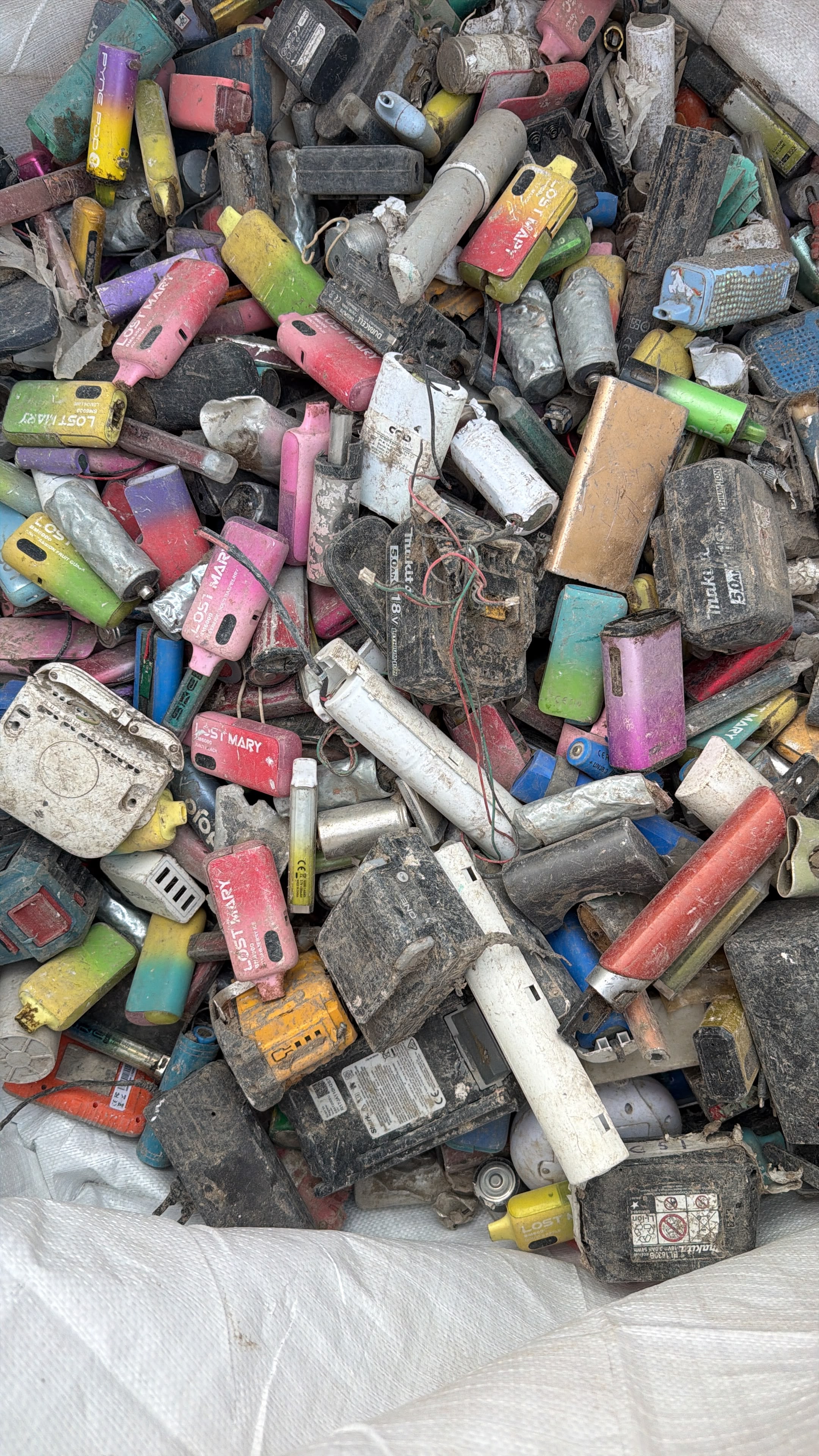
Lithium batteries should never be placed in general waste. Yet across the UK, batteries, vapes and battery-powered electrical items continue to enter the waste stream every day, creating a serious and potentially devastating fire risk.
At Sharp Skips, we see the problem first-hand. Our team regularly finds batteries and vapes entering the waste stream, and we're seeing more and more stories across social media and within our industry of other waste businesses suffering serious fires.
Our pickers regularly find batteries and vapes amongst general waste arriving at our facilities. They might be small items, but once they enter a waste processing environment, the consequences can be anything but small.
And it only takes one.
Why are lithium batteries dangerous in general waste?
When waste arrives at a waste management facility, it doesn't simply sit there.
It is tipped, moved, sorted, compacted and processed using heavy machinery and specialist equipment.
If a lithium-ion battery is crushed, punctured or otherwise damaged during this process, it can overheat and potentially catch fire.
UK Government guidance specifically warns that lithium-ion batteries can catch fire when incorrectly placed in household rubbish, particularly when damaged. Batteries and electrical products carrying the crossed-out wheelie bin symbol should instead be taken to an appropriate recycling collection point.
For those of us working in the waste industry, this isn't a theoretical risk.
It's something our teams have to be aware of every day.
More than 500 battery-related waste facility fires in a year
The scale of the issue is becoming increasingly difficult to ignore.
Figures reported in August 2026 found that there were 1,518 fires at UK recycling and waste facilities between March 2025 and March 2026.
At least 541 were directly linked to batteries, while a further 216 fires occurred in bin lorries.
That means batteries aren't simply creating a disposal problem. They're creating a significant safety and infrastructure problem for the UK waste industry.
What actually happens when a battery catches fire?
A battery thrown into general waste can travel through several stages before anyone even knows it's there.
It could be buried amongst other materials, transported in a waste vehicle and eventually reach machinery where it is crushed or damaged.
Once a battery ignites, surrounding waste can provide plenty of material for a fire to spread.
The result can put waste operatives, drivers and emergency services at risk, as well as causing extensive damage to vehicles, machinery, buildings and entire waste facilities.
During particularly hot and dry periods, preventing unnecessary sources of ignition becomes even more important.
That's why the solution needs to start before the battery reaches businesses like ours.
What about vapes?
Vapes have become a major part of the conversation surrounding battery waste.
Since 1 June 2025, it has been illegal for businesses in the UK to sell or supply single-use vapes, whether or not they contain nicotine.
However, the issue extends beyond disposable vapes.
Vapes, whether single-use or rechargeable, are electrical items containing batteries and should not be thrown into general waste or household recycling.
They need to be disposed of and recycled correctly as electrical waste.
Yet we're still seeing them entering the general waste stream.
That's the problem.
How should lithium batteries and vapes actually be disposed of?
Keeping batteries out of general waste doesn't have to be complicated.
Most household batteries can be taken to designated battery collection points, including those available at many supermarkets and larger retailers.
Where appropriate, lithium battery terminals should be taped before recycling to reduce the risk of short circuits.
Electrical products containing batteries that cannot easily be removed should be treated as electrical waste and taken to an appropriate recycling facility.
Vapes should also be recycled separately. Vape retailers have responsibilities around take-back and recycling, and dedicated vape recycling points are available in many locations.
The important message is simple: if it contains a battery, don't put it in the general waste bin.
Fire prevention can't start at the waste facility
There is rightly a huge amount of responsibility placed on waste businesses to operate safely.
We have procedures, trained staff and systems in place to identify and manage risks.
But there's only so much the waste industry can do once a lithium battery has already been hidden amongst tonnes of general waste.
Fire prevention needs to begin much earlier.
Consumers need to understand how these products should be disposed of. Businesses need appropriate systems for handling battery waste.
Manufacturers and retailers need to play their part, and regulation needs to keep pace with the products entering the market.
Something needs to change
At Sharp Skips, we've worked within the waste industry since the early 1980s.
We've seen huge changes in the way waste is collected, processed and regulated during that time.
Lithium batteries are another challenge the industry now needs to address properly.
Whether the answer involves tighter regulation, improved collection infrastructure, stronger producer responsibility, deposit-return initiatives or greater public education, we believe more needs to be done to stop batteries entering general waste in the first place.
Because waiting for another serious fire, or for somebody to get badly hurt, isn't good enough.
Would you support stronger action on lithium battery disposal?
We want to help get the conversation moving.
We believe stronger regulation and further action should be considered to prevent lithium batteries and vapes entering the general waste stream, and we know we're not the only business within the waste and recycling industry seeing the impact.
We’ll be sharing more across our social media channels, including a demonstration showing just how quickly things can go wrong when a lithium battery is damaged.
Watch our latest videos and let us know in the comments: would you support stronger action too?
If there’s enough support for change, it’s a conversation worth taking further.
The more awareness we can create around the issue, the better.